News
THE CLOSING OF SEDA WITHOUT A CLEAR MODEL CREATES RISKS FOR BUSINESSES, MUNICIPALITIES AND THE STATE
Today marks the deadline for the public consultation on the proposal to transfer the Agency’s functions to the Ministry of Energy.
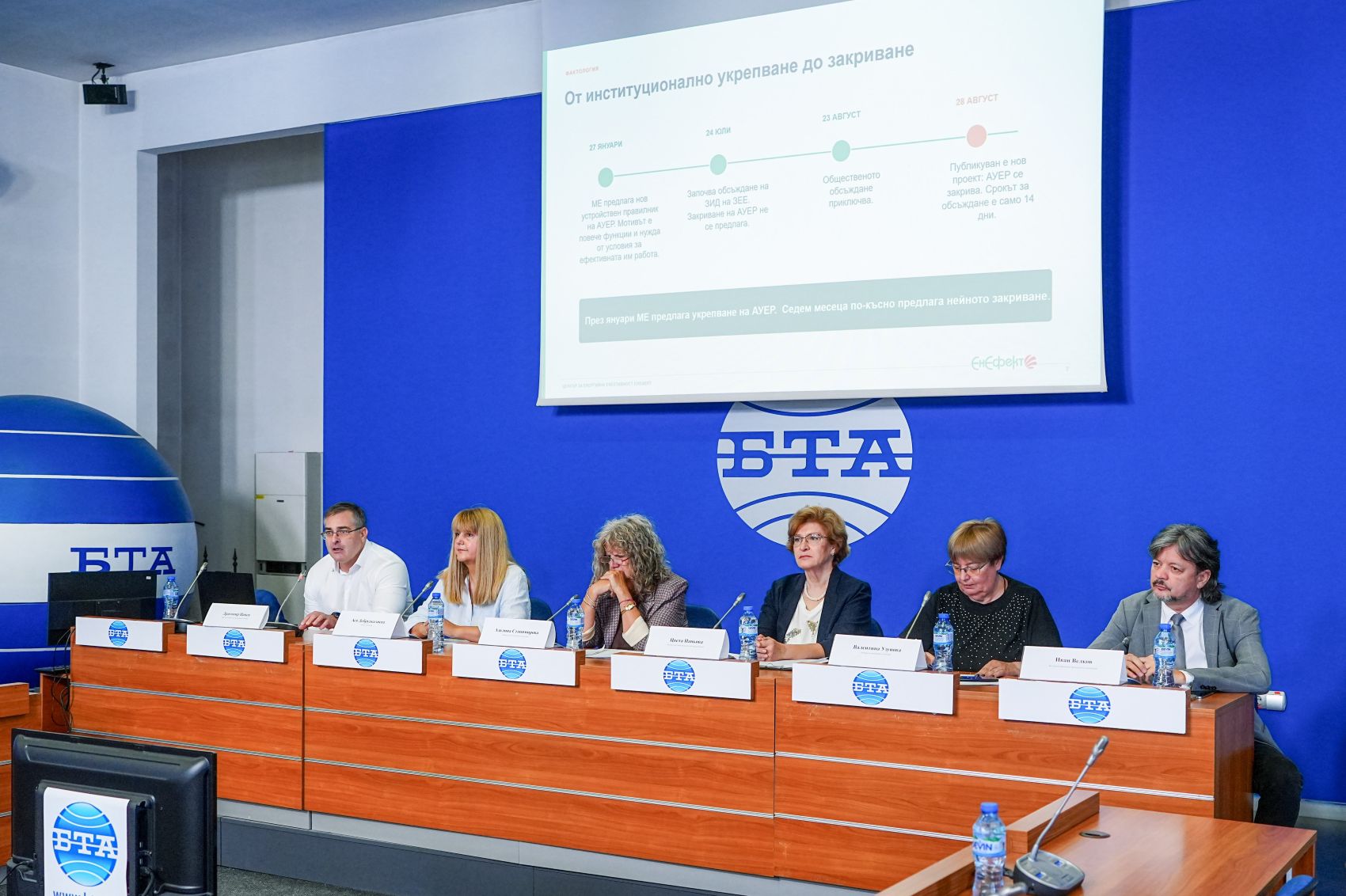
Sofia, 11 September 2026. Six professional, industry and civil society organisations have spoken out against the closure of the Sustainable Energy Development Agency (SEDA) and the transfer of its functions to the Ministry of Energy. At a press conference yesterday, their representatives warned that the proposed reform had been put forward without a published functional analysis, without a clear model for the future structure, and without a plan for the Agency’s staff, registers, information systems and ongoing procedures. In their view, this creates an immediate risk of delays and financial losses for businesses and municipalities, weaker oversight, and more difficult coordination between state institutions.
“We should not take decisions that pose risks to the professional community without a careful and publicly available functional analysis. We cannot dismantle an institution with 30 years of experience such as SEDA without having a clear reason and evidence as to why we are doing so,” said Dragomir Tzanev, Executive Director of the EnEffect Center for Energy Efficiency. He noted that energy efficiency policy cuts across numerous sectors and requires an institutional framework capable of ensuring professional expertise, public accountability and coordination between ministries, municipalities and businesses.
He stressed that the professional community is not calling for SEDA to remain unchanged, but rather for it to be strengthened and given a broader mandate. “We will continue working with government representatives and engaging in the public debate so that SEDA can become a horizontal structure while preserving its coordinating role. We will do everything possible to ensure that this solution is placed on the Government’s agenda, because it would also support its own work,” Tzanev added. According to him, this is also demonstrated by the successful work under the streamSAVE+project, through which EnEffect and SEDA have developed three new methodologies for assessing energy savings this year alone: from cooling projects and IT equipment in data centres, and from the use of mechanical ventilation with heat recovery in buildings.
The data presented during the press conference show that the stated annual savings of approximately EUR 369,000 are based on eliminating 19 of a total of 60 staff positions, but do not include the costs of the reorganisation, the transfer of information systems, potential disruption of services or the loss of experienced experts. Nor has there been any assessment of the risks to businesses, municipalities, energy auditors and construction projects arising from possible delays in certificates, registrations, inspections, reporting and payments.
“Professionalism, technical expertise and high-quality services for citizens are standards that should be established and preserved within institutions, not undermined,” said Asya Dobrudzhaliеva of Habitat Bulgaria. She highlighted the expertise accumulated within SEDA and the need to preserve its specialised capacity.
Valentina Uzunova, Chair of the Chamber of Energy Auditors, warned that the two European directives that are due to be transposed introduce new requirements for qualified professionals and independent oversight. In her view, transferring verification functions to the Ministry of Energy creates a problem. She called for the procedure to be halted and for the risks to the registers and oversight mechanisms to be assessed in advance.
From the business perspective, Adelina Stanimirova, Executive Director of the Chamber of Installers in Bulgaria, pointed out that energy efficiency, decarbonisation and the deployment of renewable energy are delivered by professionals, not through administrative restructuring. “For businesses, certainty is essential. We have worked with SEDA since the Agency was established, and there is no other organisation with which we have built such an effective working relationship,” she said. According to her, potential delays would impose costs on businesses that could exceed the stated budget savings.
Tsveta Nanyova, Executive Director of the Bulgarian-Austrian Consulting Company, stressed that energy efficiency is a horizontal policy area and cannot be managed effectively by a single ministry alone. She drew attention to the already difficult coordination between institutions and to the risk that this could be weakened further if SEDA’s independence is removed and its expert capacity reduced to a directorate within the Ministry of Energy.
“When reforms are carried out by ministries in Bulgaria, they too often create more administration rather than solutions. Public resources should be managed by managers, not only by administrators,” commented Ivan Velkov, Chair of the Bulgarian Facility Management Association. In his view, sustainable energy management requires professionals who maintain continuous contact with expert and industry communities.
The organisations are calling for the proposal to close SEDA to be withdrawn, for the European directives to be transposed through the original version of the draft legislation, and for the Agency’s future to be considered only after the publication of a functional analysis, an assessment of the required capacity, and a detailed reorganisation plan. As a possible model, they propose transforming SEDA into a state agency under the Council of Ministers, with a clear mandate for interinstitutional coordination, functionally independent oversight and public accountability.
“We call on the professional community to submit its arguments within the public consultation period, which expires today. We are calling for an open, evidence-based discussion on how SEDA can work better, rather than a rushed decision on how it should cease to exist,” Dragomir Tzanev concluded.
The full position of the EnEffect Center for Energy Efficiency on the future of SEDA is available HERE.


